Animal training: does a fixed space really help?
Hi, Romane here. A fixed space often helps an animal learn, provided it remains comfortable, predictable, and suited to its needs. When training an animal, keep a designated spot, but also let the dog move away and rest. This distinction matters at home as much as in a school setting, where a therapy dog can contribute to well-being and a calmer learning environment.
Things to do right away
- Choose a quiet spot, away from busy areas.
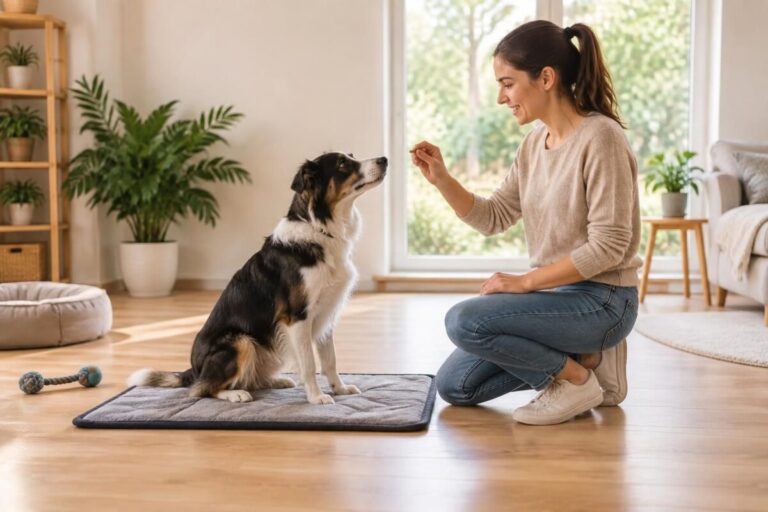
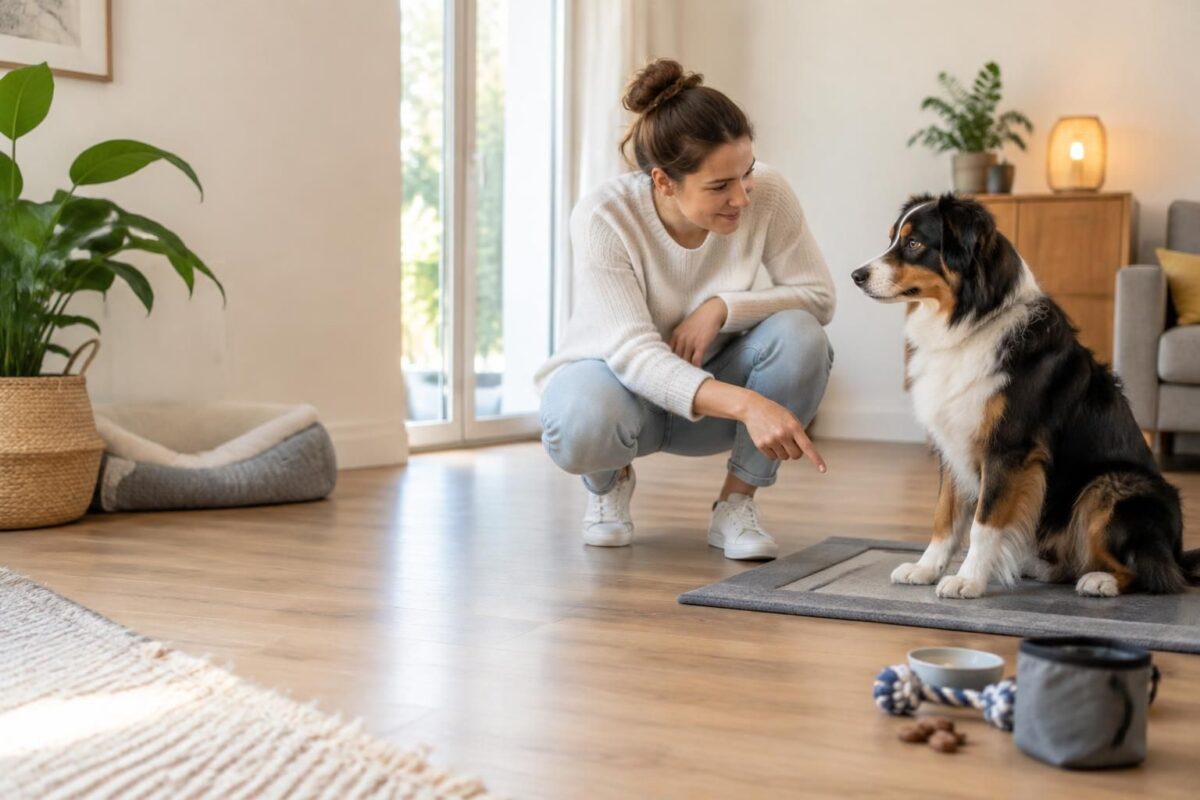
- Set up a mat or a bed to serve as a familiar spot.
- Keep this space away from play, meals, and distractions.
- Teach everyone not to disturb the animal when it is resting there.
- Watch for its signals: signs of tiredness, avoidance, or restlessness mean it needs some space.
A fixed space is not a cage or a place where the animal has to stay at all costs. It is a spatial cue that helps it anticipate the training routine; to learn more about choosing one, discover how to create a familiar spot it will keep using and how to set up its space without restricting it.
Does a fixed space really help with animal training?
Yes, often: a familiar place can reduce uncertainty and make it easier for an animal to learn. The animal understands that it can settle there without being disturbed, while the people around it learn to respect its boundaries.
At a high school, this familiar spot might be a mat in a quiet place, available as needed and in line with the agreed arrangements. Some therapy dogs stay close to their handler; others work with young people in individual sessions, on walks, or sometimes during an assessment, if the arrangements and the dog’s well-being allow.
Arrangements vary: the dog may belong to a staff member, be a school success assistance dog assigned to a handler, or be brought in by a professional animal-assisted intervention practitioner. The aim is still to support young people and create opportunities for conversation, without making the animal’s presence obligatory for students or turning it into a constant activity for the dog.
Spatial cues, without rigidity
A predictable place can help the dog find its bearings and recover between interactions. But successful training also depends on consistent rules, a calm atmosphere, and the option to move elsewhere if the animal shows signs of discomfort.
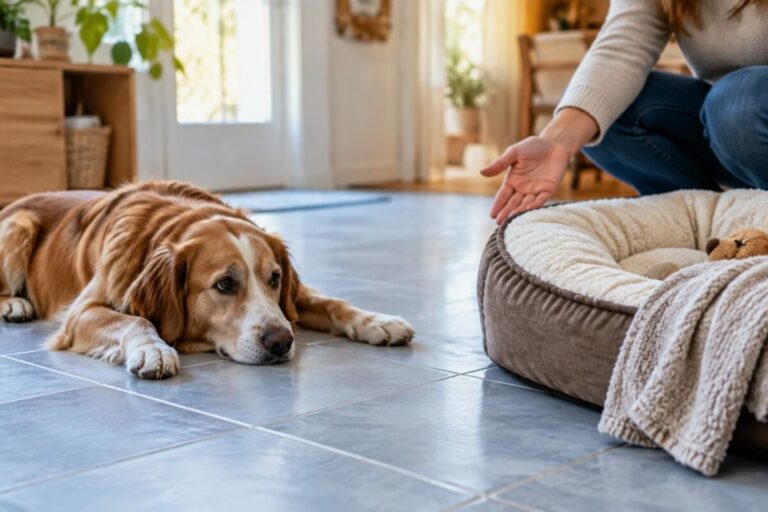
A dog that turns away, yawns frequently, licks its lips, or tries to leave may need a break. “Rest is part of learning.” A fixed space is therefore useful when it protects this time away, not when it becomes a rigid instruction.
| Situation | Suggested spot | Things to watch for |
|---|---|---|
| At home | A bed in a quiet area with little foot traffic | People disturbing the animal while it rests |
| In class or at high school | A mat in a quiet corner, chosen with the team | Noise, crowds, and unwanted contact |
| During a training session | A familiar spot with an accessible exit | Tiredness and the length of the activity |
Therapy dogs at school: an approach that respects the animal
A dog’s presence can reassure some young people, help conversations flow, or provide a starting point for talking about emotions. It can also help build connections between students and adults. However, these effects depend on the animal, the supervision, and each person’s needs: a dog is neither a performance tool nor a one-size-fits-all solution.
A brief anecdote sums up the value of clear guidelines: during a session, a very reserved student began by watching the dog from the other side of the room. Once they understood that they could choose how close to be and that the animal had a quiet corner, they joined the discussion.
These activities can also support learning about animal behavior, ethology, biology, or ecology. Young people learn to recognize signs of calm, tiredness, or irritation; this awareness encourages a more respectful relationship and connects hands-on experience with the concepts covered in class.
Three steps to create a designated space
- Step 1: Choose the spot with the animal’s handler. It should be quiet and accessible, and far enough from busy areas to allow the animal to get proper rest.
- Step 2: Associate the spot with a positive experience without forcing the dog to stay there. A familiar mat and regular breaks can help create a reassuring training routine.
- Step 3: Observe and adjust. If the animal avoids the spot or struggles to relax there, change its location, reduce distractions, or provide another place to retreat.
If it’s a young dog new to these sessions, start with short, quiet periods and gradually increase them based on its response. If it’s a dog that’s already used to them, keep its familiar spot while also providing another place to rest when the area gets too busy.
A useful training routine, as long as it stays flexible
Training does not mean keeping an animal in a particular spot. Rather, it means teaching it simple cues while respecting its pace and temperament. A familiar space can support this learning, but it does not replace breaks, attentive supervision, or an approach suited to the animal’s behavior.
To protect animal well-being, establish shared rules: who may approach the dog, when, and how to recognize that it wants to be left alone. In a school, this preparation also helps make the arrangements clear to young people and the educational team.
The right spot is one the animal willingly chooses and where it can truly relax. Consistency is reassuring; the freedom to move away protects the relationship.
Practical questions about a fixed space
Is a fixed space enough to train an animal?
No. It helps create familiar cues, but should be combined with consistent rules, breaks, and training suited to the animal.
Does the dog always have to stay in its space in class?
No. Its space is a refuge and a familiar spot, not somewhere to confine it. It must be able to move away and rest without being disturbed.
How can you tell if the location is suitable?
A dog that willingly rests there and seems relaxed is a sign that the spot may suit it. If it avoids the place or seems restless, adjust the environment and reduce distractions.
Does a fixed space improve the effectiveness of training?
It can help by making situations more predictable. Its impact depends on the context, the animal’s temperament, and whether its needs are respected.
Thank you for your interest; Romane