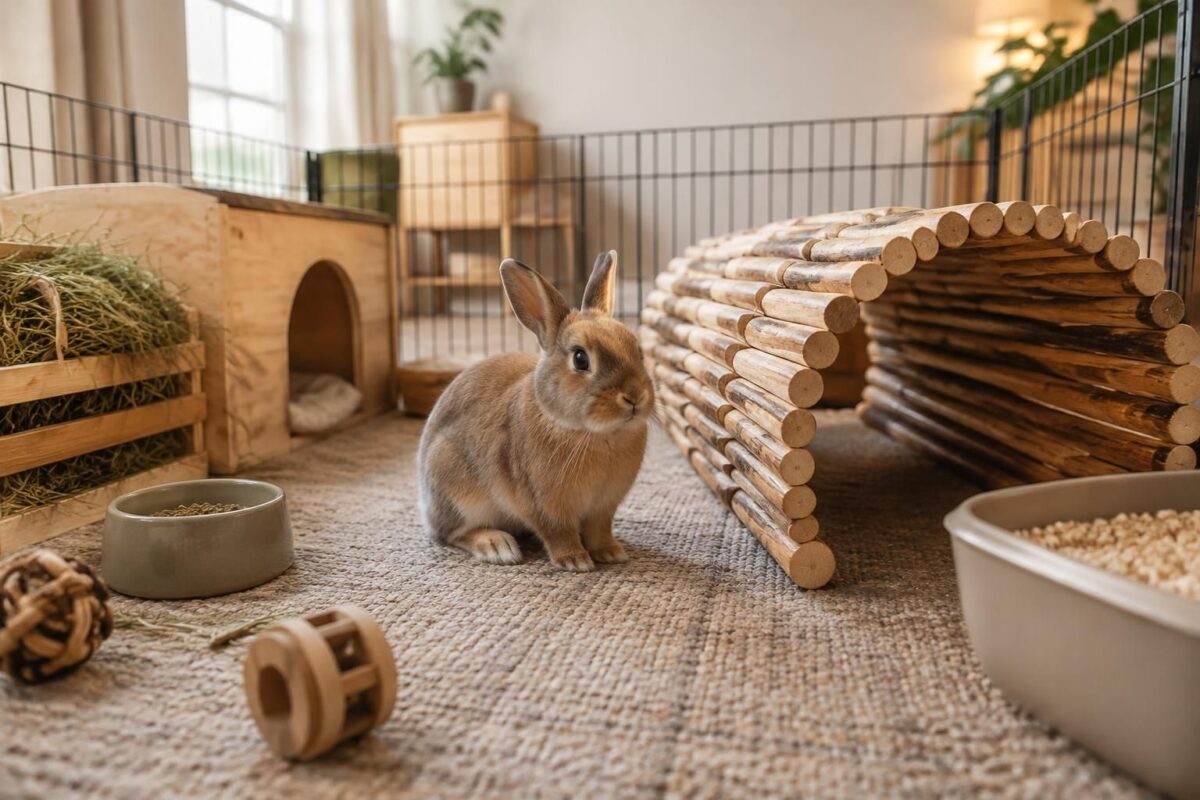
Animal habitat: does this make its space less practical?
Hello, Romane here.
Yes, an overly cluttered setup can make your pet’s space less practical and less comfortable.
A poorly placed bed, too many accessories, or a bulky piece of furniture can get in the way of your pet’s movements. A few adjustments are often enough to make the space functional and reassuring again.
Things to do right away
- Clear the pathways between the sleeping area, water, and food.
- Observe your pet’s habits before moving their belongings.
- Remove rarely used accessories that take up valuable space.
- Keep your pet’s resources accessible, especially if they are older or have difficulty moving around.
- Check that furniture, beds, and platforms are stable.
Built-in furniture can make storage easier, but it should not make it harder for your companion to access their belongings: these tips on built-in furniture and hidden space can help you identify the trade-offs. To assess whether a storage solution really helps in everyday life, also check out this overview of storage solutions.
When the layout makes the space less practical
A common pitfall is adding things to improve comfort without checking how much room is left to move around. But your pet’s living space should let them rest, drink, eat, and move away when they feel the need.
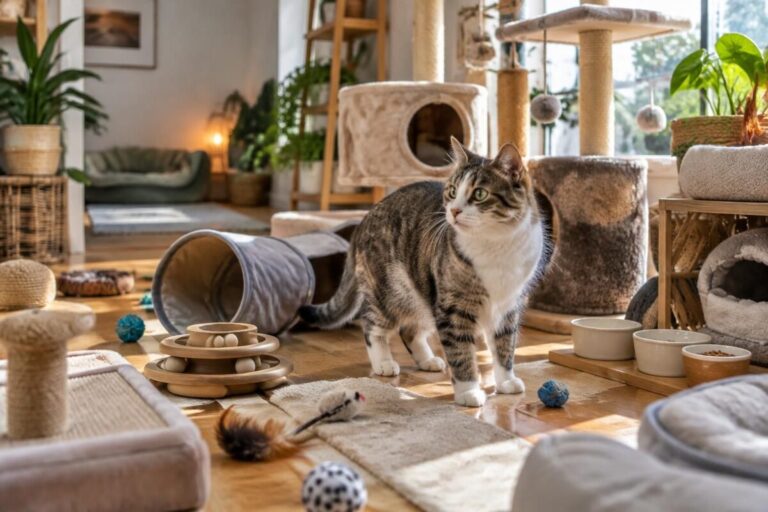
Imagine Nala, a cat who loves watching the room from her cushion. After a large shelf and several toys are added, the path to her litter box becomes narrow. She hesitates, goes around the objects, and eventually chooses somewhere else to lie down: this change may be a sign that the functionality of her living space has declined.
Practicality therefore does not depend on the number of accessories, but on where they are placed and how your pet actually uses them. A simple, stable, and easy-to-navigate setup supports animal well-being.
Signs that a space has become cluttered
Notice whether your companion has to step over objects, avoids an area, or can no longer turn around easily in their bed. Reduced accessibility can also be noticeable when they hesitate to reach their food bowl or litter box.
A change in behavior is not always related to the layout: pain, stress, or illness may also play a part. If the difficulty persists, ask a veterinarian for advice rather than assuming that simply moving something will be enough.
Compare the setup before and after
| Feature observed | Practical setup | Problematic setup |
|---|---|---|
| Pathways | Clear access to important areas | Objects blocking or narrowing the route |
| Sleeping area | A quiet, stable spot that is easy to reach | A bed squeezed into a corner or exposed to constant foot traffic |
| Accessories | A few items suited to the animal’s habits | A buildup of items that limits movement |
| Storage | Belongings are accessible without encroaching on your pet’s space | Furniture that hides a resource or creates an obstacle |
Making the best use of space does not mean putting everything away down to the last detail or removing your pet’s familiar landmarks. It is about preserving distinct areas and easy-to-follow routes, while taking their size, age, and habits into account.
Preserve comfort without sacrificing functionality
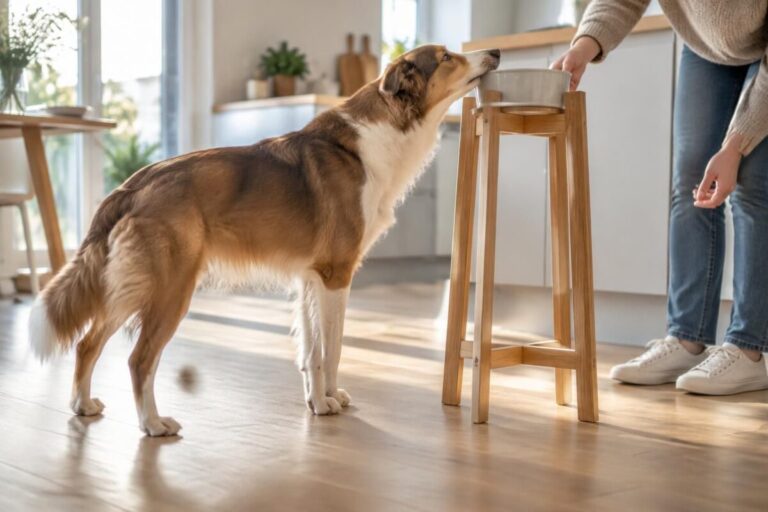
A dog that has difficulty standing up has different needs from a young cat that climbs and explores. For the dog, a bed on the floor that is easy to access and away from drafts may be a priority. For the cat, a stable platform can enrich their environment, provided it does not block a pathway.
The same principle applies to accessories: keep the ones that meet a practical need, then observe how your pet responds. Your pet’s comfort can be seen in their everyday habits, not just in how the room looks.
At the scale of natural environments, habitat loss and fragmentation also make it harder to move around and access resources. In Canada, species at risk often face several threats at once, such as pollution, climate change, and habitat alteration. Whether at home or in nature, preserving accessible spaces helps living beings meet their needs.
Reorganize the space in three steps
- Identify essential routes. Map the paths between resting areas, water, food, and, depending on the species, the litter box or exit. Note where your pet hesitates or takes a detour.
- Reduce clutter. Move unused items and secure the furniture. Avoid changing all your pet’s familiar landmarks at once: make changes gradually.
- Observe, then adjust. For a few days, check whether your pet moves around more freely and uses their usual areas again. If a problem remains or is accompanied by a change in behavior, seek veterinary advice.
A well-designed pet habitat does not have to be perfect: it should be safe, accessible, and suited to the real life of its occupant.
Practical questions about your pet’s living space
How can I tell if my pet’s space is too cluttered?
Look for blocked pathways, unusual detours, and areas your pet avoids. Also make sure their resources are still easy to reach.
Should I remove all unused accessories?
Not necessarily. Set aside items that take up space without being used, but keep the familiar things your companion is attached to.
Where should I put my pet’s bed?
Choose a stable, quiet spot away from busy pathways, while making sure your pet can get to it easily.
Could a change in layout explain unusual behavior?
Yes, a new layout can disrupt familiar landmarks. If the change persists, gets worse, or seems to be associated with pain, ask a veterinarian for advice.
Take good care of your companion, and share your observations in the comments. — Romane