How to Train a Budgie to Step onto Your Finger
Hi, it’s Romane. To tame a budgie and teach it to step up onto your finger, first get it used to your presence and your hand, then reward every voluntary approach without pushing it. Move forward in small steps: trust matters more than speed. Here’s how to offer your finger or a perch, recognize a refusal, and make progress at its own pace.
How to tame a budgie: from your hand to your finger
Training takes place in several phases, each with its own tips. Here’s a clear and effective guide:
- Observation and familiarization: First, let your budgie get used to your presence without forcing it. Its cage should be placed in a quiet spot where it can see your movements without being frightened.
- Gradually introducing your hand: Get it used to your hand by placing it gently nearby without trying to touch it. Repeat this step several times a day.
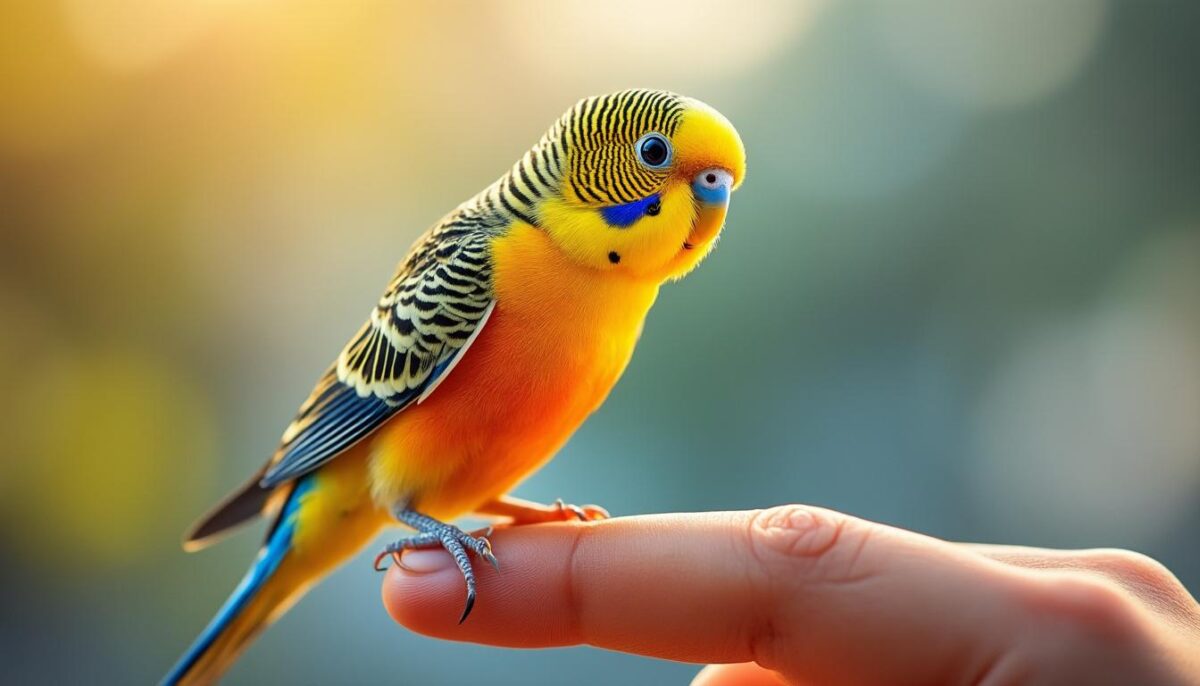
- Offering your finger: Once it calmly accepts your hand, hold a steady finger at the level of its feet, near its perch. First reward it for approaching, then for placing one foot on your finger, and finally both. Don’t push against its belly.
- An alternative using a perch: If it is afraid of fingers, offer a small, smooth, stable perch suited to its feet. A target stick is meant to be touched with the beak to guide a movement: it is not an object for pushing the bird, nor necessarily a perch. Avoid pointed skewers.
- The verbal cue: Pair a simple word such as “Up!” with it stepping onto the stick or your finger. Repetition and consistency are essential here.
- Immediate positive reinforcement: Immediately reward a successful attempt with a very small portion of its favorite food, such as a few millet seeds, without withholding its usual food allowance.
- Progress and repetition: Start with a few very short attempts. Keep your hand still once the bird has stepped onto it, then offer it a return to its perch. Gradually increase the time or distance moved only if it remains comfortable.
- Gradually phasing out the stick: Gradually offer your finger next to the perch you’re holding and reward it for voluntarily moving over. Keep the perch as a useful option if fingers make it uncomfortable.
For example: if it eats near your hand but backs away from your finger, stay at the previous step. Reward its calm behavior, then offer your finger a little farther away on another attempt. Don’t try to complete the whole step in one day.
Mistakes to avoid for successful training
It’s crucial never to rush your budgie. Forcing a bird to step onto your finger can make it wary, or even lead to a complete refusal in the long term. Always prioritize:
- Slow, measured movements that don’t frighten it.
- A gentle, positive voice, even when things get difficult.
- No sudden or abrupt movements that make the bird jump.
- Never opening the cage abruptly or trying to grab the budgie by force.
- Avoiding long sessions so it doesn’t lose patience.
If it moves away, freezes, tries to flee, or nips, stop approaching and give it space. The RSPCA recommends positive sessions at the bird’s pace, with a quick reward and no punishment. A refusal is information that you should make the exercise easier.
The ideal equipment to make training your budgie easier
Choose equipment based on your budgie’s safety and size rather than on a brand. Useful items include:
- A familiar space: Clear enough for your exercises, with a stable perch near the door and somewhere the bird can retreat to.
- A small reward: Suitable food the bird enjoys, given in a very small amount.
- A handheld perch: Not pointed, free of splinters, and with a diameter suited to its feet.
- A steady hand: With no sudden movements, and your finger offered as a support rather than a source of pressure.
- A safe environment: Doors and windows closed, fans turned off, and other animals kept away before letting the bird out.
A suitable environment increases the bird’s willingness to learn and makes each session more productive.
How the environment affects your budgie’s behavior
A calm, safe setting makes learning much easier. Remember to:
- Avoid loud noises and sudden movements.
- Place the cage in a lively but quiet area.
- Make sure your budgie has areas of shade and balanced natural light.
- Change its water and feed it regularly to support its well-being.
Even when relaxed, a budgie may refuse your finger. Respect its choice, practice stepping up onto and down from a perch, and end with an easy exercise.
How long does it take to tame a budgie?
The time varies depending on its history and how much it trusts you. There is no guaranteed number of days: move forward only when it remains comfortable with the previous step.
What should I do if my budgie won’t step onto my finger?
Don’t push. Move your hand back a little, reward a voluntary approach, or use a handheld perch before offering your finger again.
How should I reward my budgie?
Immediately offer a very small portion of suitable food it enjoys. Keep water and its usual food allowance available.
Should I push against its belly to make it step up?
No. Offer a steady support and reward small steps forward. Forcing it to step up can undermine its trust.
What should I do if my budgie nips me?
Stay calm, place it on a safe support, and stop the exercise without punishing it. Try again later with an easier step; a sudden change in behavior warrants veterinary advice.
Thank you for your interest; Romane